
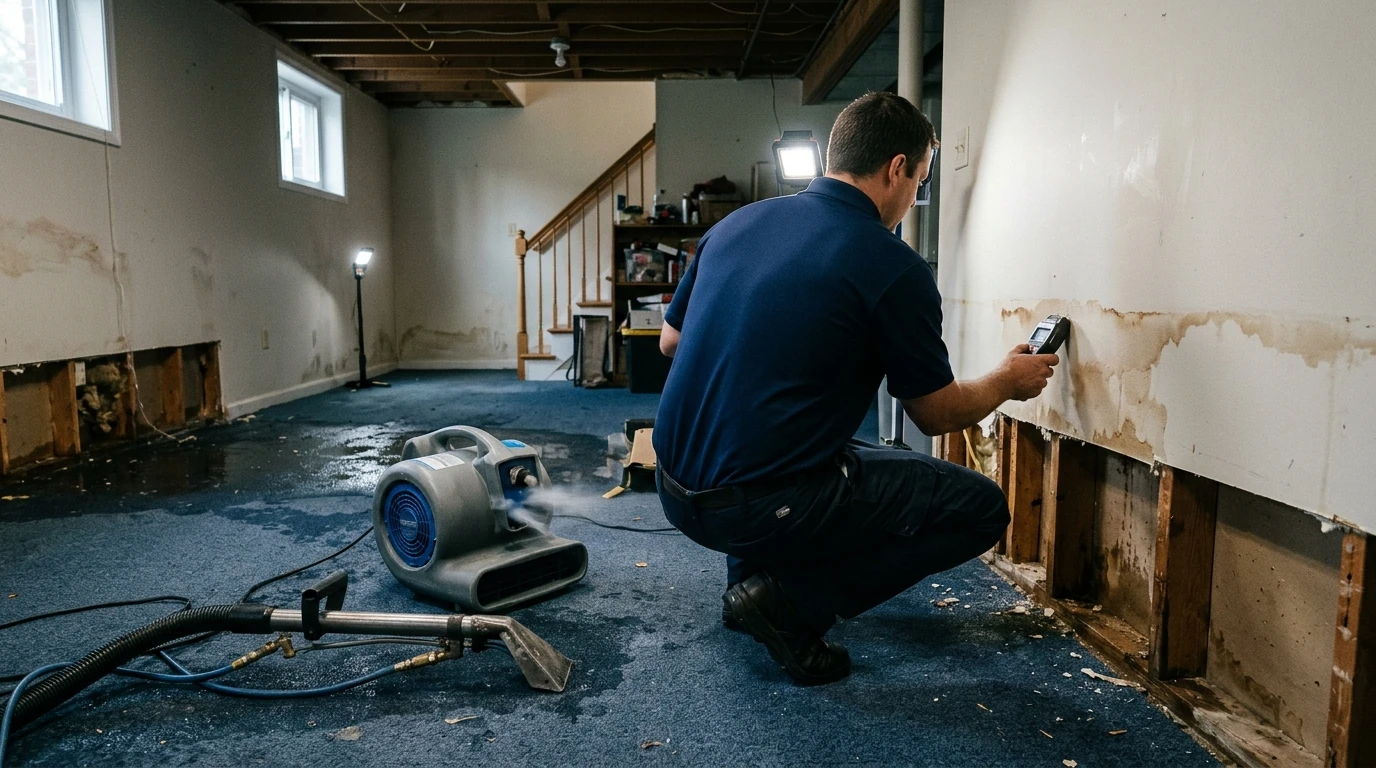
TL;DR: Flooded basement cleanup in Rockville, MD typically costs $1,500 to $4,000 for a small unfinished basement with clean water, and $5,000 to $10,000 or more for a finished basement with gray or black water contamination. The biggest cost drivers are water category, square footage, how much drywall and flooring has to come out, and how fast the water gets extracted. A standard homeowners policy rarely covers groundwater flooding (that needs a separate flood policy) or sewer backup (that needs a water backup endorsement), so check your policy.
If water just came up through your basement floor drain after last night’s storm, or your sump pump quit and you woke up to two inches standing on the carpet, the first question is usually “what is this going to cost me?” before “how did this happen?” The honest answer depends on three things: what kind of water it is, how much of the basement is finished, and how long the water sat before someone pulled it out. Here’s how those factors actually move the number in Rockville and the rest of Montgomery County.
How much does flooded basement cleanup cost in Rockville, MD?
Most basement flood cleanups in the Rockville area fall between $1,500 and $10,000, with the low end covering a small unfinished space with clean water and the high end covering a finished basement with contaminated water and significant material removal. Jobs involving extensive demolition, structural drying equipment left running for a week, or a large square footage can run higher.
Here’s a general range by scenario. These are typical industry figures, not a quote: every basement is different, and a written scope after an on-site assessment is the only way to know your actual number.
| Scenario | Typical cost range |
|---|---|
| Unfinished basement, clean water, under 500 sq ft | $1,500 - $3,000 |
| Unfinished basement, clean water, 500-1,000 sq ft | $2,500 - $4,500 |
| Finished basement, clean to gray water, carpet and some drywall removed | $4,000 - $7,000 |
| Finished basement, gray or black water, flood cut on multiple walls | $6,000 - $10,000+ |
| Sewage backup (black water) in a finished basement | $7,000 - $12,000+ |
| Large or multi-room basement with structural drying (hardwood, concrete) | $8,000 - $15,000+ |
The factors that push a job toward the high end: how much of the basement is finished space versus storage, how long the water sat before extraction started (mold can begin growing in wet materials within 24 to 48 hours, per the EPA), and whether the water came from a sanitary source or something contaminated.
Does a finished basement cost more to clean up than an unfinished one?
Yes, a finished basement almost always costs more because there’s more to remove, dry, and replace. An unfinished basement with a concrete floor and exposed framing might only need extraction and air movers running for a few days. A finished basement usually means wet carpet pad, drywall that has wicked water up the wall, baseboards, and sometimes insulation behind the wall, all of which typically need to come out rather than just dry in place.
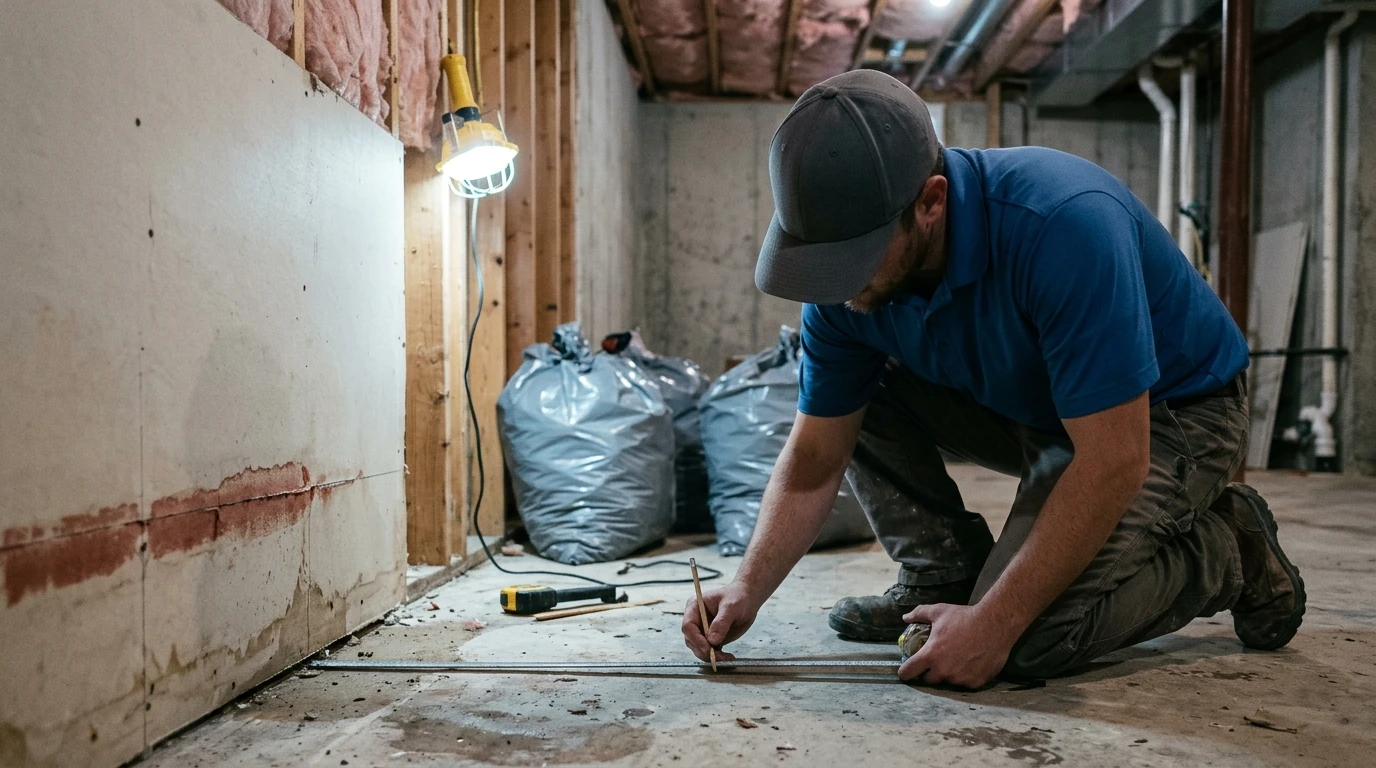
That removal work, often called a flood cut when drywall is cut a foot or two above the waterline, adds labor and disposal cost that an unfinished space never incurs. It’s also why finished basements take longer: drying equipment has to run until moisture readings in the framing and subfloor hit a safe range, which can be 3 to 7 days depending on how saturated the materials got.
A recent job RestoPros of Central Maryland documented in Olney involved water damage spreading across multiple finished basement rooms, which is a good example of how quickly a single source of water can affect several rooms once it travels under flooring and through shared wall cavities.
What’s the cost difference between clean water and sewage backup cleanup?
Sewage backup cleanup costs more than clean-water extraction because the water is classified as Category 3 (black water) under the IICRC S500 standard, which means contaminated materials get removed rather than dried in place, and the crew needs PPE and antimicrobial treatment that a clean-water job doesn’t require.
A burst supply line or a failed water heater is Category 1, clean water, which can sometimes be extracted and dried without removing much material if the response is fast. Water that comes in through a foundation crack under hydrostatic pressure (groundwater pushing in during heavy rain) is Category 2, gray water, which carries more contamination and usually means some carpet and pad removal. Any backup coming from a floor drain, toilet, or sewer line past the trap is Category 3 and should never be treated as lower risk. That distinction alone can add $2,000 to $5,000 to a job of the same square footage.
What does insurance pay for basement flooding?
Most standard homeowners policies do not cover basement flooding caused by groundwater or surface water at all, since that needs a separate flood policy, and a sewer backup is covered only if you’ve added a water backup endorsement. A standard policy generally covers sudden, accidental water damage from inside the home, like a burst pipe, but flood damage (rising water, storm surface water) requires a separate flood policy through the National Flood Insurance Program or a private flood carrier, and sewer or sump pump backups require a water backup endorsement added to your homeowners policy.
That means two basements with identical water on the floor can have completely different claim outcomes depending on the source and the policy in place. Our guide to homeowners insurance and water damage breaks down what’s typically covered versus excluded in more detail, and the Insurance Information Institute has a good plain-language overview of how disaster coverage generally works. If you’re not sure which category your water falls into or what your policy covers, get that answered before you sign anything with a contractor.
Who should you call for a flooded basement in Rockville?
Call a water damage restoration company as soon as the water source is stopped, since every hour the water sits increases both the drying cost and the mold risk. RestoPros of Central Maryland answers the phone 24/7 and documents the water category, moisture readings, and affected materials before work begins, which is exactly the paperwork an insurance adjuster asks for later.
If you’re still not sure whether this is a plumber call or a restoration call, our who to call for a flooded basement post walks through that decision in order. For whole-house water damage pricing beyond just the basement, see our water damage restoration cost guide for Rockville.
Getting a written scope before work starts is the single best way to avoid a surprise invoice. Ask for the square footage affected, the water category, and what’s being removed versus dried in place, in writing, before anyone starts cutting drywall.
About RestoPros of Central Maryland
RestoPros of Central Maryland employs IICRC-certified technicians (IICRC WRT) serving Rockville, Silver Spring, Bethesda, Gaithersburg, Columbia and the surrounding Montgomery, Prince George’s, Howard and Anne Arundel County communities. The company is licensed and insured, answers calls 24/7, and holds a 4.9 Google rating across 29 reviews. Their crews handle water damage restoration, sewage cleanup, mold remediation, fire and smoke damage restoration, storm damage restoration, odor removal, and contents restoration and storage across the region.
Need help now? Call RestoPros of Central Maryland at (240) 261-1639.