
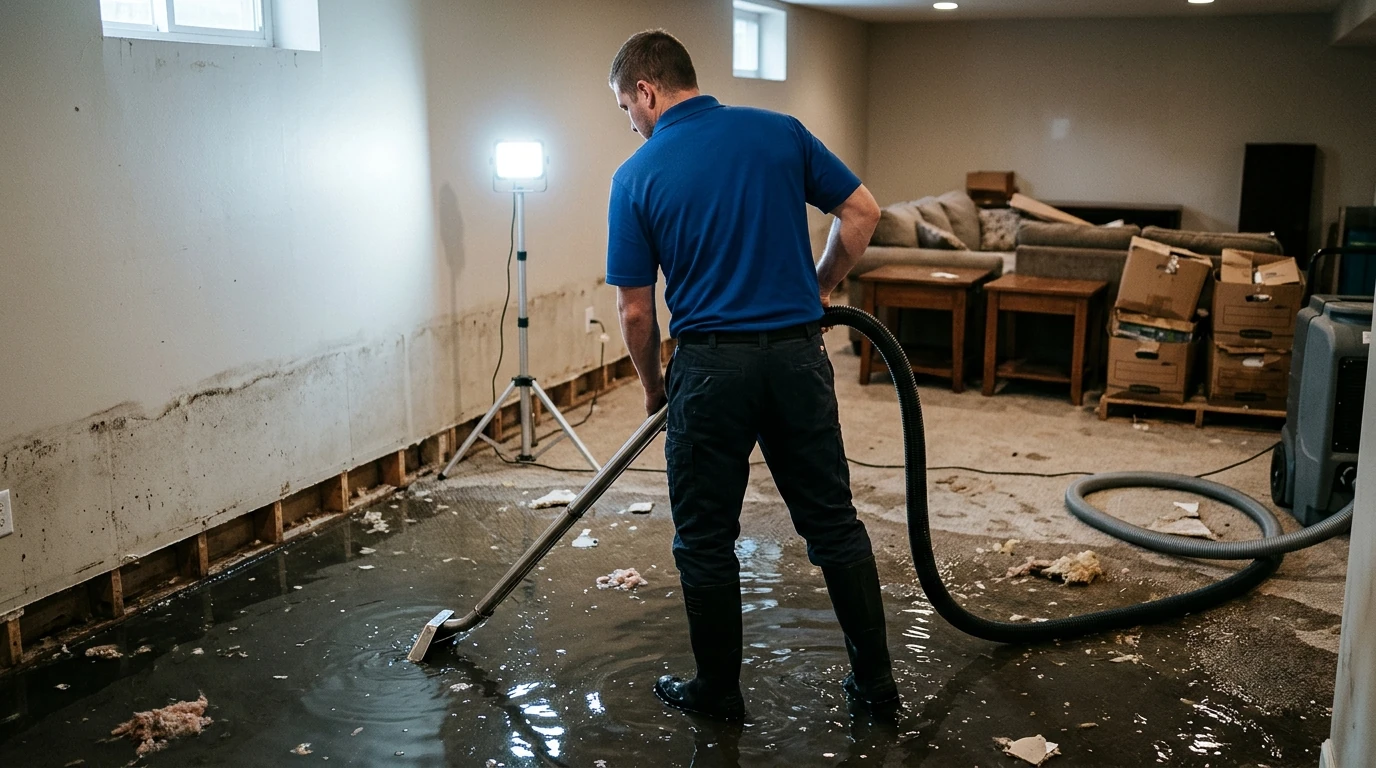
If your basement floor is standing in water in Rockville right now, call RestoPros of Central Maryland at (240) 261-1639. We answer the phone 24/7, our technicians carry an IICRC Water Restoration Technician (WRT) certification, and Rockville homeowners have rated us 4.9 out of 5 across 29 Google reviews. Before that call, though, a couple of things in the next five minutes change how much damage you end up with, because the order you make calls in actually matters.
Who do you call first when your basement floods?
Call in this order: handle any electrical hazard, stop the water source if it’s safe to reach, then call a restoration company and your insurer at roughly the same time. A flooded basement with water near outlets, a furnace, or the electrical panel is a shock hazard before it’s a cleanup problem, so that comes first, every time.
If water is rising near your panel or any outlets, don’t wade in. Call Pepco or a licensed electrician to cut power to that circuit before anyone steps into the water. Once it’s safe, look for the source: a tripped or burned-out sump pump, a cracked foundation wall after heavy rain, a supply line feeding the house, or a backed-up floor drain. If it’s a running supply line you can reach, shutting the main valve stops it from getting worse. If it’s a WSSC Water main break outside the house, that’s a utility call, not a plumbing one.
Once the source is handled, or if water keeps coming in faster than you can manage, call RestoPros. This is the core of our water damage restoration work, and standing basement water starts soaking into drywall, subfloor, and insulation within the first hour. Mold can begin growing on wet materials within 24 to 48 hours, so the sooner extraction starts, the less gets torn out later.
Is a flooded basement covered by homeowners insurance?
Usually not, and the reason depends on where the water came from. A standard homeowners policy typically covers sudden, accidental water damage from inside the home, like a burst supply line, but most policies exclude flood, groundwater seepage, and sump pump failure unless you’ve added specific coverage.
If your sump pump failed and groundwater flooded the basement, that’s usually only covered with a water backup (sump/sewer) endorsement on the policy. The same goes for a sewer or drain backup. If water came in as surface runoff during heavy rain, that’s a flood, which standard homeowners policies exclude entirely; it requires a separate policy through the National Flood Insurance Program or a private flood carrier. Our guide on whether homeowners insurance covers water damage walks through these distinctions in more detail. Whatever the source, photograph everything and keep receipts before cleanup starts; a documented loss is easier for an adjuster to evaluate fairly.
Is basement floodwater Category 2 or Category 3?
It depends on the source, and getting this right changes how the cleanup is handled. Under the IICRC S500 standard, groundwater seeping in through a foundation wall under hydrostatic pressure is Category 2 (gray water), contaminated enough to require careful handling. Surface water flowing in from outside during a storm, and any sewer or drain backup, is Category 3 (black water), the most contaminated classification, which calls for antimicrobial treatment and PPE during cleanup.
This matters for what gets dried versus removed. Category 2 and 3 water usually means carpet padding, baseboards, and sometimes drywall get removed rather than dried in place. If you notice a sewage odor or discoloration along with the standing water, treat it as Category 3 and keep the basement off-limits to kids and pets until a crew has assessed it.
What if my sump pump failed, or heavy rain caused the flooding?
A failed sump pump and a storm-driven basement flood both need the same first move: get the water out before it sits long enough to reach drywall and framing. If the pump itself failed, whether a stuck float switch, a tripped breaker, or a worn-out motor, that’s a plumber’s fix for the equipment, but the standing water already in the basement is a separate, time-sensitive job that doesn’t wait on a parts order.
Older homes near Rockville Town Center and Twinbrook, and homes closer to Rock Creek’s tributaries, tend to sit on clay-heavy soil that holds water against the foundation longer after a heavy storm, which is part of why repeat basement flooding shows up in these neighborhoods after just a few inches of rain. Either way, call RestoPros once water is standing. This falls under our basement flooding cleanup and broader flood damage restoration work, and we bring truck-mounted extraction and commercial dehumidifiers to pull water and moisture out of the slab, framing, and any wet contents before mold establishes. If you’re seeing mold from a previous flood rather than this one, our guide to who to call for mold in a Rockville basement covers that situation specifically.
What happens when you call RestoPros for a flooded basement?
On the first call, we’ll ask what you already know: whether the water is still rising, where it’s coming from if you can tell, and roughly how much of the basement is affected. Have your address and, if you have it, your insurance information ready; it speeds up the paperwork later.
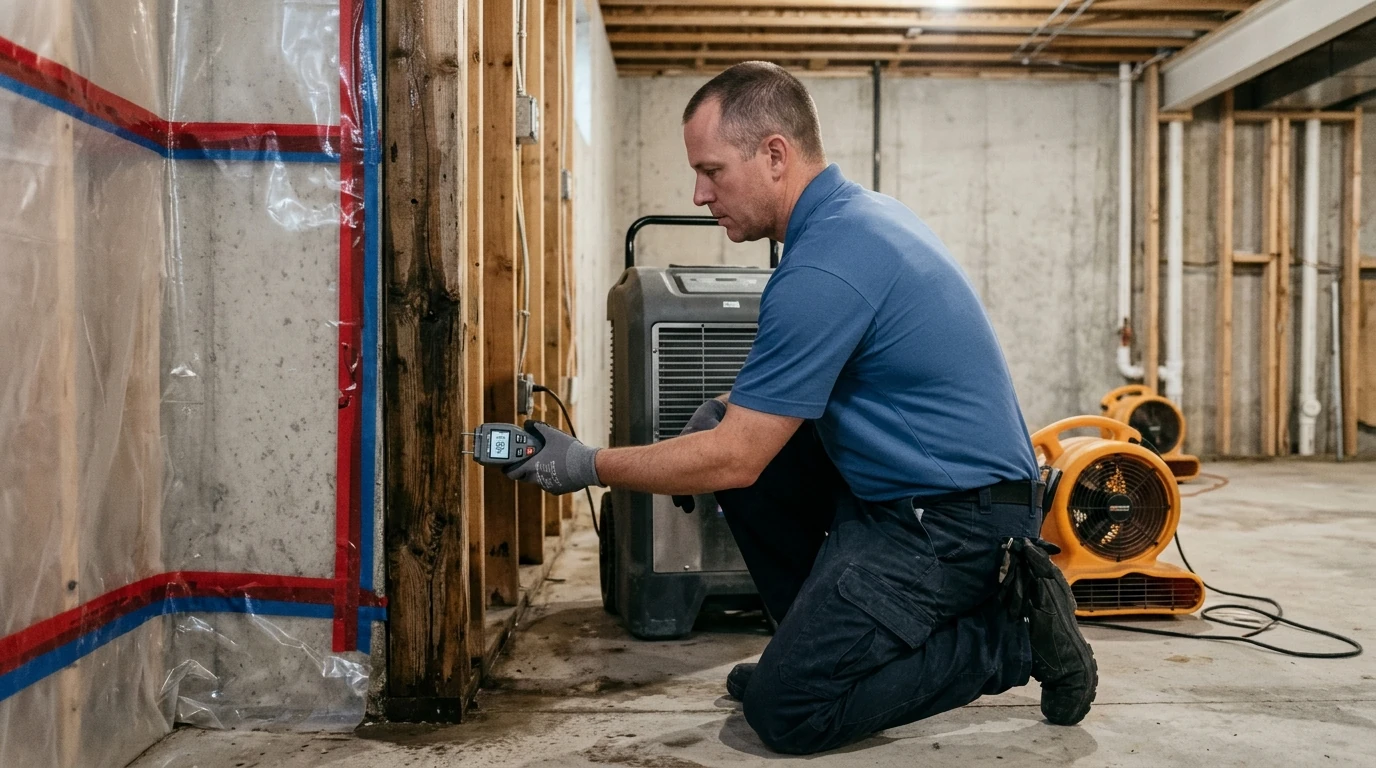
A crew arrives with extraction equipment, moisture meters, and air movers for emergency water removal, and the first hour is spent pumping standing water and tracing how far it traveled under flooring and into wall cavities. We document the loss with photos and moisture readings as we go, which becomes the record your insurer will want if the claim is covered. From there we set drying equipment and monitor it over several days until the space actually reads dry, not just looks dry. Anything needing antimicrobial treatment for Category 2 or 3 water happens before drying wraps up.
A finished basement in Olney that took on water across several rooms followed roughly this path, documented in one of our case studies: extraction first, then structured drying, then a clear handoff of documentation for the insurance claim.
If you’re not sure whether your basement issue is isolated or part of a larger water event affecting the rest of the house, our guide to who to call for water damage in Rockville covers the whole-house version of this decision tree, and what to do in the first 24 hours after water damage has the fuller checklist beyond just the phone calls.
Standing water in a basement doesn’t wait for a convenient time. Call RestoPros of Central Maryland at (240) 261-1639 and we’ll walk you through next steps before a crew is even on site.
About RestoPros of Central Maryland
RestoPros of Central Maryland employs IICRC-certified technicians serving Rockville, Silver Spring, Bethesda, Gaithersburg, Columbia, and the surrounding Montgomery, Prince George’s, Howard, and Anne Arundel County communities. The company is licensed and insured, answers the phone 24/7, and holds a 4.9-star Google rating across 29 reviews. This post was prepared with input from Daniel Restum and the RestoPros team, who handle water damage, flood and storm cleanup, sewage cleanup, mold remediation, fire and smoke damage, and odor removal across Central Maryland.