Large Loss and Catastrophic Response in Rockville
24/7 large loss and catastrophic response in Rockville and surrounding areas. IICRC-certified, insurance billing accepted. Call (240) 261-1639.
When a pipe bursts above an occupied office floor, a storm tears into a garden-style apartment complex, or a fire moves through a shared commercial roofline, the damage doesn’t stay contained to one unit or one trade. Large loss and catastrophic response is what happens when a water, fire, or storm event crosses a threshold most residential restoration teams aren’t built for: multiple structures, multiple stakeholders, and a dollar figure that demands coordinated project management instead of a single crew with a few air movers. Because RestoPros of Central Maryland operates 24/7, mobilization on a large or catastrophic loss starts the moment the call comes in, not the next business day.
What large loss and catastrophic response actually involves
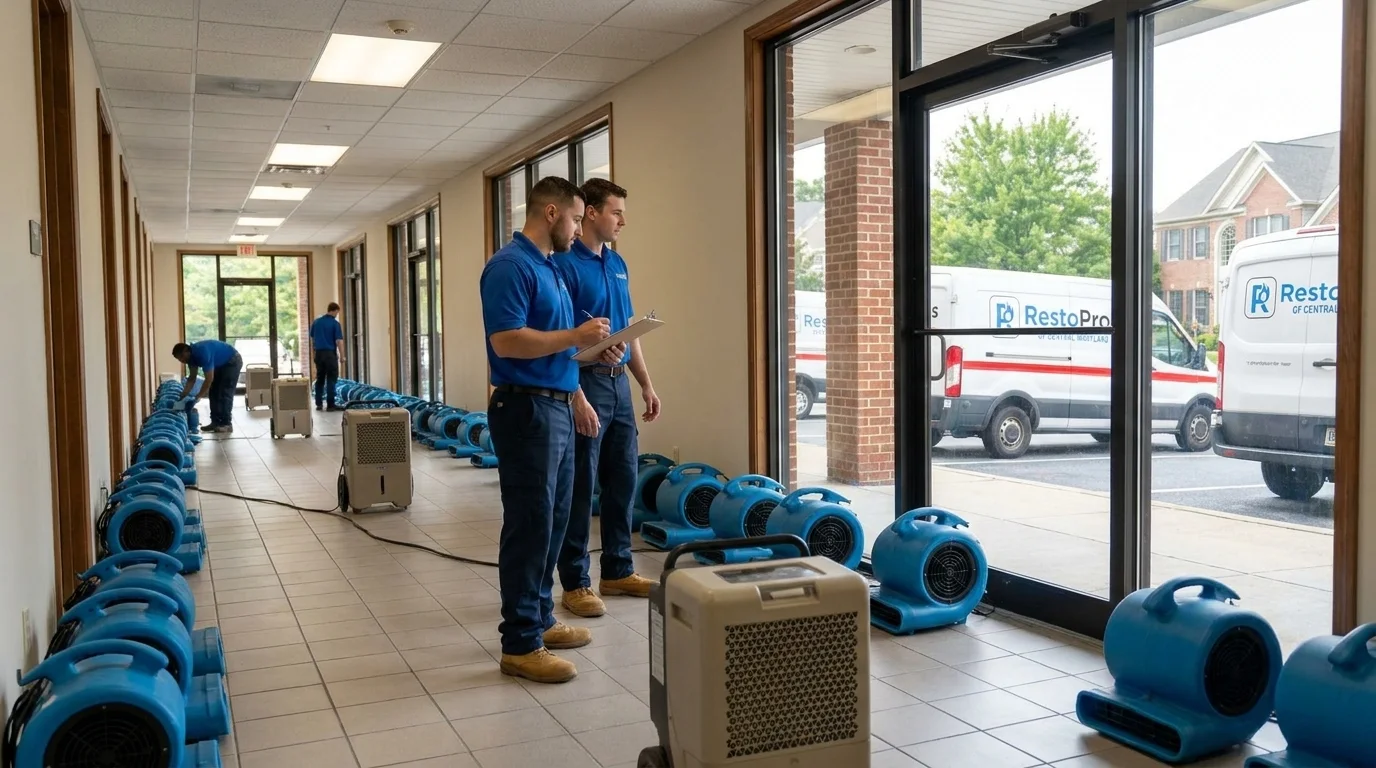
Large loss work is defined less by the cause of damage and more by its scale and complexity: a multi-story office building with saturated ceiling tile on three floors, a 40-unit apartment complex after a frozen main breaks overnight, a shopping center with smoke migration through shared HVAC runs. These jobs typically involve more than one building system, more than one insurance stakeholder (property manager, ownership group, individual tenant policies), and equipment needs measured in dozens of dehumidifiers and air movers rather than two or three. Timelines run weeks to months instead of days, and the work has to be sequenced so that occupied portions of a property stay usable while damaged areas are mitigated.
Our process
- Rapid mobilization and structural triage. Crews assess the full footprint of the loss first, not just the most visible damage, identifying which areas are safe to occupy, which need immediate containment, and where water or smoke has likely migrated beyond the obvious source.
- Scope development across the full loss. Rather than scoping room by room, the team builds a master scope that accounts for shared systems (HVAC, electrical risers, common corridors) and categorizes water intrusion per IICRC S500 guidance where water is involved.
- Resource and equipment deployment at scale. Large loss jobs require pre-calculated drying chamber volumes, staged equipment logistics, and often multiple subcontracted trades working in sequence rather than in parallel, so scheduling is managed as a single project rather than isolated work orders.
- Daily documentation and adjuster coordination. Moisture readings, drying logs, and photo documentation are tracked per affected area and shared on a schedule that matches what large loss adjusters and third-party administrators expect for ongoing claim review.
- Phased closeout and reconstruction handoff. Areas are released for repair or reconstruction as they hit drying or cleaning benchmarks, allowing partial reoccupancy instead of waiting for the entire property to be cleared at once.
What separates a good large loss response from a bad one
The most common failure on a catastrophic loss is under-resourcing it: treating a 60-unit building like a large single-family job and sending equipment sized for a basement, not a complex. That shows up fast in the drying logs when humidity won’t drop despite days of runtime. A second common miss is documentation that doesn’t scale with the property. Insurance adjusters on large claims expect unit-by-unit or floor-by-floor moisture and photo records, not a single generalized report, and gaps in that paper trail are where claims stall or get disputed. Secondary damage is also easy to miss in multi-story or multi-tenant buildings: water that traveled through a shared wall cavity or smoke that settled in an adjacent unit’s HVAC return often isn’t found until weeks later if the initial assessment only covered the unit of origin. A well-run large loss response maps the full extent before equipment goes in, documents at the granularity the claim actually needs, and keeps occupied portions of the property functioning while the damaged sections are mitigated in phases.
What does large loss and catastrophic response cost?
Costs on large loss and catastrophic jobs vary enormously based on square footage, number of affected units, cause of loss, and how long the structure sat before mitigation began, so any number should be read as a typical industry range rather than a quote. RestoPros of Central Maryland provides a written scope of work before mobilizing major resources so the property owner and carrier both know what’s included. Most catastrophic claims involving a covered peril (burst pipe, wind, fire) are covered under a commercial property policy, though deductibles and coverage limits for multi-unit losses should be confirmed with the carrier before work begins.
| Scenario | Typical range |
|---|---|
| Single-floor commercial water loss (clean water) | $15,000 - $50,000 |
| Multi-unit apartment building, frozen pipe break | $75,000 - $300,000 |
| Commercial fire with smoke migration across multiple units | $100,000 - $500,000 |
| Large-scale storm damage to a commercial complex | $150,000 - $750,000 |
| Catastrophic multi-building loss with major structural damage | $500,000 - $2,000,000+ |
Seasonal & regional considerations
Montgomery County’s older garden-style apartment complexes and office parks along the I-270 corridor carry plumbing and roofing systems that are decades old in places, and a hard winter freeze-thaw cycle can take out a shared main line overnight, affecting dozens of units before anyone notices standing water. Summer brings the Mid-Atlantic’s share of remnant tropical systems and derecho-style wind events, both of which can produce roof and window failures across an entire building face at once rather than a single isolated leak. Because catastrophic losses in this region are often tied to shared infrastructure, a response plan has to account for how damage moves through a building, not just where it started.
Service area
RestoPros of Central Maryland responds to large loss and catastrophic events throughout Rockville and across Montgomery County, including Gaithersburg, Bethesda, Silver Spring, and Germantown, mobilizing crews and equipment sized to the scope of the property rather than a single unit.
If you’re managing a multi-unit, multi-floor, or multi-building loss and need a team that can scope and staff the response at the right scale from the first call, request a large loss assessment from RestoPros of Central Maryland at (240) 261-1639.
Frequently Asked Questions
What actually qualifies a loss as "large loss" rather than a standard restoration job?
How does working with a large loss adjuster differ from a standard homeowner's claim?
How is staffing different on a catastrophic multi-building loss compared to a single-family job?
Does commercial property insurance cover large loss and catastrophic restoration?
What should a property manager do in the first hours after discovering a catastrophic loss?
Looking for the best large loss and catastrophic response company in Rockville?
RestoPros of Central Maryland provides large loss and catastrophic response in Rockville, MD and the surrounding area. Customers rate us 4.9 out of 5 stars across 28 Google reviews. We answer calls 24/7 — call (240) 261-1639 for immediate help.
Need Large Loss and Catastrophic Response now?
We respond 24/7 across Rockville and surrounding MD cities.